Customers are starting to shop differently.
Instead of opening Google, browsing multiple Shopify stores, and comparing products manually, many shoppers now ask AI assistants a simple question:
“What’s the best waterproof hiking backpack under $100?"
The AI evaluates products, compares features, checks availability, and presents a shortlist of recommendations. In some cases, the shopper may never perform a traditional search at all.
This shift is creating a new discovery channel for Shopify brands: AI-powered product recommendations.
A Shopify Agentic Storefront is Shopify’s response to this shift. It enables eligible merchants to make their product catalogs understandable to AI shopping assistants, allowing them to retrieve product information, answer shopper questions, recommend relevant products, and guide customers toward checkout.
For Shopify brands, this isn’t about replacing traditional eCommerce. It’s about participating in a new commerce channel that’s already changing how customers discover and buy products.
Shopify Agentic Commerce vs. Shopify Agentic Storefront
These terms are related, but they don’t mean the same thing.
Shopify Agentic Commerce (The Bigger Picture)
Shopify Agentic Commerce is the broader shift toward AI-powered shopping, where AI agents help customers:
- Discover products
- Compare options
- Answer buying questions
- Recommend products
- Guide shoppers through purchasing
Instead of searching multiple websites, customers can increasingly rely on AI shopping assistants to complete much of the buying journey.
Shopify Agentic Storefront (Shopify's Implementation)
A Shopify Agentic Storefront is the technology that allows AI shopping assistants to interact with participating Shopify stores.
Rather than relying only on web pages, AI assistants can access structured product information and commerce data to:
- Understand your product catalog
- Retrieve accurate pricing and inventory
- Recommend products that match customer intent
- Direct shoppers toward Shopify Checkout
How Shopping is Changing
| Traditional Search | Shopify Agentic Commerce |
|---|---|
| Visit Google | Ask an AI shopping assistant |
| Browse multiple stores | AI compares products |
| Read reviews manually | AI summarizes trade-offs |
| Check inventory yourself | AI verifies availability |
| Choose a product | AI recommends a shortlist |
Why Shopify Built This Infrastructure?
AI assistants can already read websites. The problem is they don’t always understand them correctly.
Traditional web scraping can lead to:
- Outdated prices
- Incorrect inventory
- Missing specifications
- Confusing product variants
- Misinterpreted product information
Instead of relying solely on scraped webpages, Shopify’s Agentic Storefront infrastructure provides AI systems with structured, real-time commerce data.
This gives AI shopping assistants a more reliable source of truth when recommending products, helping merchants improve visibility while giving customers more accurate information.
How Does a Shopify Agentic Storefront Work?
The shopping journey is surprisingly simple.
1. The shopper asks a question, for example: “Find me a lightweight carry-on backpack for business travel under $120."
2. AI understands the shopper’s intent: The assistant identifies key buying criteria such as budget, category, features, size, and intended use.
3. AI retrieves structured product information: It accesses details like titles, descriptions, specifications, pricing, inventory, and shipping information.
4. Products are compared: The AI evaluates available products against the shopper’s requirements.
5. Recommendations are presented: The shopper receives a shortlist of products that best match their request.
6. Customer completes checkout: Once the shopper makes a decision, the purchase continues through Shopify Checkout.
Key takeaway: Unlike traditional search engines that primarily index web pages, AI shopping assistants rely on structured product information, pricing, availability, and merchant policies to recommend products that best match a shopper’s intent.
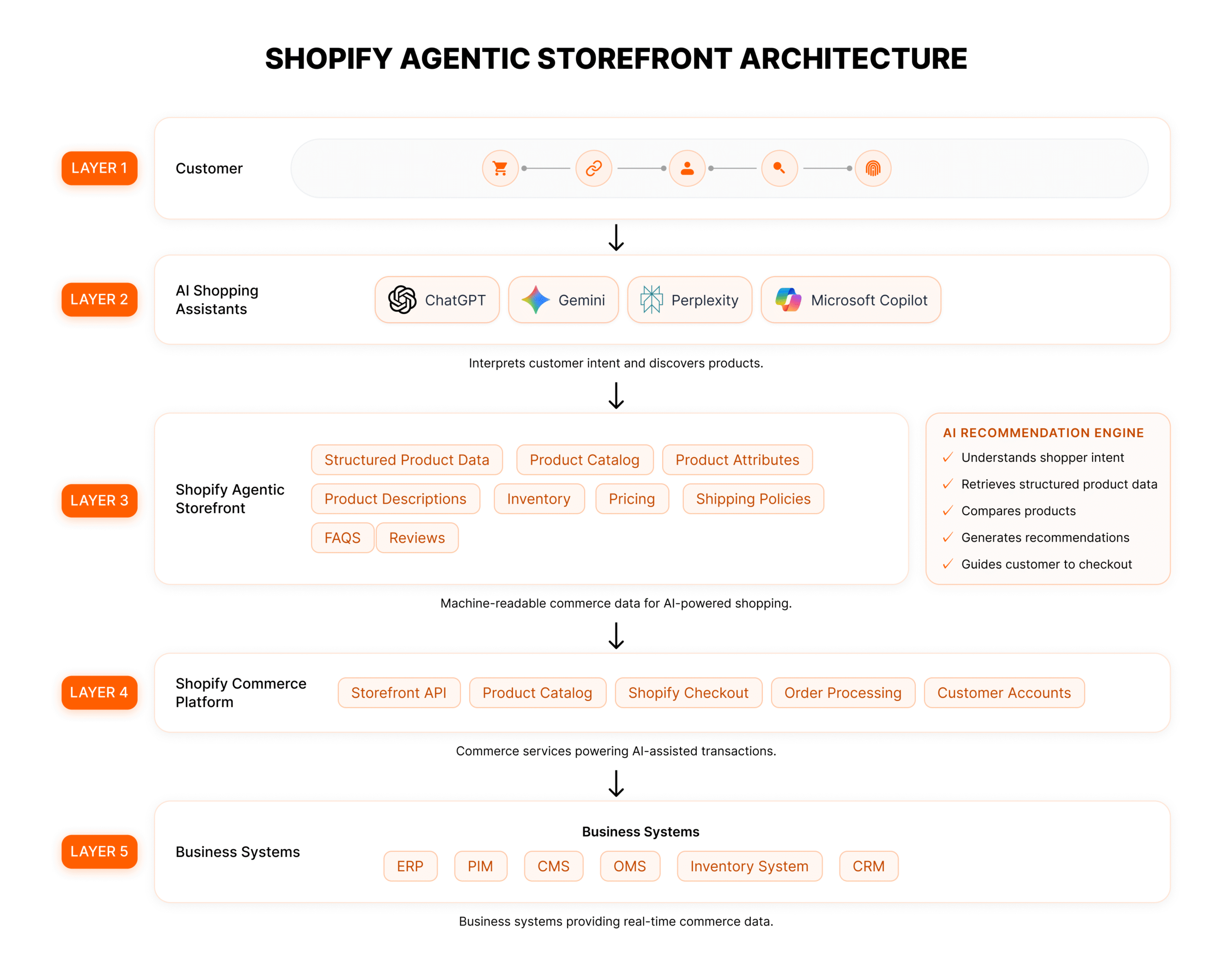
The architecture below illustrates how Shopify Agentic Storefronts connect AI shopping assistants with structured product data and Shopify’s commerce infrastructure.
Why a Shopify Agentic Storefront Doesn't Guarantee AI Recommendations
Enabling a Shopify Agentic Storefront is an important first step- but availability alone doesn’t guarantee recommendations.
When AI shopping assistants compare products, they still need answers to practical questions:
- Is this product the best match for the shopper’s request?
- Which variant should be recommended?
- Is pricing and inventory current?
- Does the product contain enough information to outperform similar alternatives?
- Are compatibility details, shipping policies, and restrictions clearly defined?
Many Shopify product pages were originally written for human shoppers. AI shopping assistants, however, rely on structured product information to compare products objectively, and future AI shopping assistants.
How to Prepare Your Shopify Store for AI Shopping
The good news? You don’t need to redesign your website to support Shopify AI Shopping. Most merchants already have the foundation- they simply need to make their product information easier for AI shopping assistants to understand.
1. Review Your Store's AI Readiness
Start by checking whether Shopify Agentic Storefront capabilities are available for your store and which AI shopping channels are supported. Availability can vary based on Shopify’s rollout, your region, and eligibility requirements.
If AI-powered shopping is part of your growth strategy, reviewing these settings is a good first step.
2. Improve Structured Product Information
AI shopping assistants rely on product data-not just marketing copy.
Review every product to ensure it includes:
- Descriptive product titles
- Complete product descriptions
- Materials and specifications
- Dimensions and sizing
- Compatibility details
- Product variants
- Intended use cases
The richer and more consistent your product information is, the easier it becomes for AI to recommend the right products.
3. Keep Commerce Data Accurate
Outdated information creates poor shopping experiences.
Regularly verify:
- Inventory availability
- Product pricing
- Variant information
- Shipping details
- Return and warranty policies
If your store uses metafields, custom apps, or third-party integrations, ensure those data sources remain synchronized across your catalog.
4. Publish Customer-Friendly Policies
AI shopping assistants increasingly reference customer-facing content when answering buying questions.
Make sure your store includes:
- Shipping policies
- Return policies
- Warranty information
- FAQs
- Product restrictions (where applicable)
These pages help AI assistants provide more accurate answers while building trust with potential customers.
5. Test Real Shopping Prompts
Don’t stop at enabling Shopify Agentic Commerce.
Try asking AI shopping assistants the same questions your customers would ask, such as:
- “Best waterproof backpack under $100"
- “Gift for a new parent under $75"
- “Laptop bag for business travel"
Review the recommendations and identify any missing product details that could improve your visibility in AI-powered shopping experiences.
SEO vs. GEO: The Next Optimization Layer
Preparing your Shopify store for AI-powered shopping isn’t just about traditional SEO anymore.
It’s also about making your product information easy for AI systems to understand and recommend- a practice increasingly referred to as Generative Engine Optimization (GEO).
| Traditional SEO | GEO (Generative Engine Optimization) |
|---|---|
| Optimize for search engines | Optimize for AI recommendations |
| Focus on keywords | Focus on structured product information |
| Improve page rankings | Improve recommendation quality |
| Increase search visibility | Increase AI discoverability |
GEO doesn’t replace SEO. Instead, both work together to improve how customers discover your products across search engines and AI-powered shopping experiences.
Is Your Shopify Store AI-Ready?
Before you publish, ask yourself:
- Product titles are descriptive.
- Descriptions include detailed specifications.
- Product attributes are structured consistently.
- Inventory syncs in real time.
- Pricing is accurate.
- Shipping and return policies are clearly published.
- FAQs answer common customer questions.
- Product reviews are actively maintained.
- Images include descriptive alt text.
If several boxes remain unchecked, your store may not yet be fully prepared for AI-powered shopping.
Conclusion - What's Next?
Preparing for Shopify Agentic Commerce is an ongoing process. Start by focusing on the areas that have the greatest impact on AI-powered product discovery.
- Audit your product catalog.
- Improve product information and structured attributes.
- Verify inventory and pricing accuracy.
- Update customer-facing content, including FAQs and policies.
- Monitor new Shopify AI commerce capabilities as they become available.
These foundational improvements not only support AI shopping assistants but also strengthen your overall eCommerce experience.
If you’re planning your AI commerce roadmap, Digital Radium can help assess your current Shopify setup with expert Shopify Implementation Services and identify the technical improvements needed to build an AI-ready storefront.
FAQ
Do I need to enable Shopify Agentic Storefronts manually?
Not always. Shopify is rolling out Agentic Storefront capabilities to eligible merchants, and availability may vary depending on your store and region. It’s a good idea to review your Shopify Admin settings and Shopify’s latest documentation to understand which AI commerce features are available for your store
Will AI shopping replace my Shopify website?
No. Your website remains the primary storefront, while AI assistants provide a new channel for customers to discover products before completing a purchase.
How do I prepare my Shopify store for AI shopping?
Ensure your product data is descriptive and structured, including accurate inventory, pricing, and clear shipping policies to make recommendations easier for AI assistants.
Do I need to redesign my Shopify store?
No. Preparing for AI shopping focuses on improving your product catalog and commerce data rather than changing your website’s visual design.
Why aren't my products appearing in AI shopping results?
There isn’t a single reason. Product visibility depends on factors such as your store’s eligibility, the quality of your product information, inventory accuracy, structured data, and how well your products match a shopper’s request. Optimizing these areas can improve how AI shopping assistants understand and recommend your products.
Is it too early to prepare for Shopify Agentic Commerce?
No. Even if AI-powered shopping continues to evolve, the work you do today-improving product information, organizing your catalog, and maintaining accurate commerce data-also strengthens SEO, customer experience, and overall store quality. It’s a practical investment that delivers value beyond AI
Will a Shopify Agentic Storefront improve SEO?
Not directly. However, the best practices for AI readiness, such as structured information and accurate content, also strengthen your store’s overall SEO foundation.
Need technical assistance?
Schedule a 30-minute discovery session with our Magento architects.
FREE CONSULTATION