Manual catalog management in Magento is often a silent drain on your resources. While scaling your SKU count is the goal, it usually triggers a wave of unstructured supplier spreadsheets, “copy-paste" descriptions, and the high-stakes risk of attribute errors that break your site’s navigation.
If you are still relying on the “spreadsheet-and-import" method, you are likely facing a significant delay between receiving new inventory and getting those products live in front of your customers.
The Shift to Autonomous Ingestion
Magento AI catalog automation shifts the paradigm from manual data entry to autonomous orchestration. By deploying AI agents, you move away from static CSV imports toward a dynamic AI-powered product data automation model.
Instead of your team spending hours on data entry, these agents handle the complex processing:
-
- Interpreting unstructured supplier PDFs or raw data sheets.
- Auto-generating SEO-optimized technical specs and descriptions.
- Validating data integrity against your specific taxonomy before it hits the server.
In this blog, we’ve highlighted how building a dedicated Magento catalog ingestion pipeline eliminates your “upload" phase entirely. And, how this approach replaces repetitive manual chores with a self-sustaining system, ensuring your products are live in a fraction of the time.
Why Manual Catalog Workflows Break at Scale in Magento
Scaling your SKU count often exposes the limitations of traditional catalog management. As your inventory grows, several factors contribute to operational friction:
- SKU Volume Growth: The sheer number of updates exceeds manual capacity, leading to significant delays in product launches.
- Supplier Data Inconsistencies: Managing varying formats, from raw CSV/PDF feeds to unstructured data, requires constant normalization
- Attribute Mapping Errors: Manual entry often results in misclassified attributes, breaking your layered navigation.
- SEO Metadata Gaps: High-volume uploads often lead to generic or missing metadata, which directly impacts your search visibility.
- Manual Review Bottlenecks: Every product requires a human touchpoint for validation, creating a permanent lag between inventory arrival and live sales.
What Is Magento AI Catalog Automation?
Magento AI catalog automation is a self-governing system that uses agentic AI to dynamically interpret, enrich, and validate product data.
Unlike basic tools that require perfectly formatted files, this system handles the “pre-processing", automatically mapping raw data to your store structure.
How AI Agents Replace Manual Catalog Work in Magento
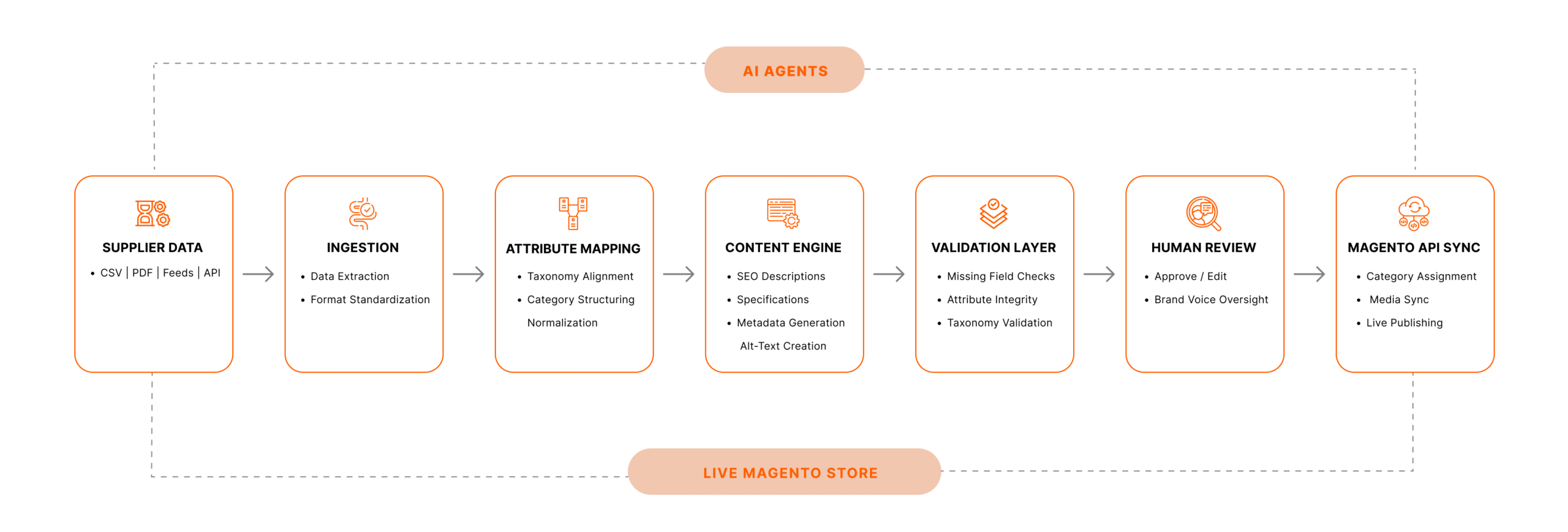
AI agents act as an intelligent bridge between raw supplier data and your live storefront, transforming the “spreadsheet-and-import" routine into a high-velocity, autonomous workflow.
These agents allow your team to focus on strategy rather than entry.
-
- Automated Ingestion: Agents monitor your CSV/PDF feeds, extracting product data as soon as it becomes available.
- Intelligent Mapping: AI normalizes inconsistent supplier terms to match your specific Magento taxonomy.
- SEO Enrichment: Every SKU receives high-converting descriptions and meta tags automatically.
- Media Tuning: Images are resized, with keyword-rich alt text generated instantly.
- Integrity Checks: The system validates data before publishing, preventing navigation-breaking errors.
- Instant Sync: Finalized data pushes directly to your store via the Magento REST API.
When your workflow follows this sequence, you stop fixing spreadsheets and start operating a governed system that scales with your catalog growth.
What Changes When Your Catalog Uploads Are Fully Automated
When you bridge the gap between your supplier feeds and storefront with AI, you stop ‘managing’ a catalog and start maintaining a category.
|
Feature |
Manual Upload |
AI-Powered Upload |
|
Data Ingestion |
CSV cleanup and manual formatting |
Automated extraction and attribute mapping from feeds or PDFs |
|
Product Content |
Copy-paste from supplier sheets |
AI-generated, SEO-optimized descriptions and metadata |
|
Speed to Live |
Days per batch |
Same-day publishing after validation |
|
Accuracy |
Frequent attribute mismatches |
Validation against your taxonomy before publishing |
|
Team Focus |
Data entry and corrections |
Merchandising and growth initiatives |
Stop Managing Uploads. Start Managing Scale.
Eliminate your manual catalog cycles in Magento and move from spreadsheet cleanup to structured automation.
A Real-World Use Case: Eliminating Manual Catalog Uploads
We recently worked with a growing retail brand on Magento that was scaling rapidly, had multiple suppliers, experienced frequent seasonal drops, and added thousands of new SKUs. While revenue was booming, their catalog workflow was stuck in the past.
The Challenge: When Growth Outpaces the Grid
- Data Chaos: Every supplier sent data in a different mess of CSVs, PDFs, and raw spreadsheets.
- The “Cleanup" Loop: The team spent days manually fixing typos and mapping attributes to their store’s taxonomy.
- Broken Navigation: Manual entry led to frequent attribute mismatches, breaking their site’s faceted search and filters.
- Delayed Launches: Launch timelines were slipping by days, leaving them missing out on peak demand for new inventory.
The Approach: Structured AI Automation
We implemented an AI-driven catalog workflow designed to replace manual preparation entirely. The system:
- Ingestion Agents normalize data from any supplier format instantly.
- Enrichment Agents generate SEO-ready content and optimize media assets.
- Validation Agents cross-check every data point for integrity before it goes live.
- Routes listings to a human approval dashboard so nothing goes live without oversight
- Publishes directly to Magento via API, eliminating manual import cycles
The Outcome: Scalable, Predictable Growth
The results were transformative. The preparation that used to take four days now happens in four hours. With attribute errors eliminated and SEO consistency locked in, the operations team has finally moved from “cleanup duty" to high-level growth strategy. Theydidn’t just automate a task; they built a scalable engine for market dominance.
Conclusion
The key takeaway is this: eliminating manual catalog uploads in Magento requires structure, not just automation. When your catalog operates through a governed pipeline, you reduce errors, accelerate launches, and free your team to focus on growth instead of cleanup.
And if you’re ready to move beyond spreadsheet-driven uploads, our Magento Development Services are designed to build those scalable automation frameworks that grow with your business.
FAQ
How do I eliminate manual catalog uploads in Magento?
Replace spreadsheet imports with an automated pipeline that ingests supplier data, maps attributes, validates errors, and publishes through Magento APIs with approval controls.
What’s the architecture for AI-based catalog automation?
It consists of data ingestion, attribute mapping, content enrichment, validation logic, and a governed publishing layer connected directly to Magento.
Can AI auto-map product attributes in Magento?
Yes. AI can interpret supplier fields and align them to your Magento attribute structure, reducing taxonomy mismatches and broken filters.
How do AI agents handle attribute mapping and data validation?
They apply structured rules and contextual analysis to match fields accurately and flag inconsistencies before publishing.
Is AI catalog automation reliable at scale?
Yes—when supported by orchestration logic and human approval checkpoints, it can manage high SKU volumes with consistent accuracy.