Integrating your e-commerce storefront with the backend ERP is one of the most impactful decisions you make as your business grows.
When Shopify and NetSuite aren’t fully in sync, teams face data errors, manual reconciliations, and dashboards that don’t tell the same story. This is where a Celigo Shopify NetSuite integration becomes more than a connector; it acts as the operational layer that keeps orders, inventory, and customer data aligned across systems.
We’ve seen ecommerce teams use Celigo not just to move data between Shopify and NetSuite, but to create consistency across order processing, inventory updates, and customer records as operations scale.
In this blog we’ve covered:
- Common failure points in Shopify–NetSuite integrations.
- How Celigo addresses them without custom code
- What changes once systems stay reliably in sync
And what you should plan for when implementing a Shopify–NetSuite integration at scale.
Where Shopify–NetSuite Integrations Typically Break Down
Once Shopify and NetSuite are connected, the expectation is straightforward: the same data should reflect the same reality across systems. In practice, that consistency is often the first thing to erode as operations grow.
Over time, clear patterns begin to emerge that signal the integration isn’t holding up:
- Shopify and NetSuite data no longer match across reports and dashboards
- Shopify orders fail to sync to NetSuite consistently, especially during peak volume
- Inventory discrepancies force teams to manually verify availability before fulfillment
- Manual reconciliation becomes a routine task rather than an exception
At the core of these issues is a structural mismatch. Shopify is designed to move fast on the front end, while NetSuite is built to enforce control, accuracy, and accounting rigor on the back end. When the integration between them isn’t designed around how your business actually operates today, data may move, but not in a way teams can rely on.
Why Shopify–NetSuite Integration Issues Appear as You Scale
- Order volume grows beyond initial assumptions: As order volume increases, timing issues and retries become more visible, exposing limits in integrations designed for low-volume workflows.
- Operational workflows become more complex: Adding SKUs, fulfillment scenarios, discounts, refunds, and partial shipments can prevent Shopify orders from syncing with NetSuite when integrations can’t handle real-world edge cases.
- Inventory becomes harder to manage across systems: An inventory mismatch between Shopify and NetSuite creates overselling risk, fulfillment delays, and uncertainty around available stock.
- Teams compensate with manual processes: Spreadsheets and spot checks become routine, turning manual reconciliation from a temporary fix into a daily dependency.
- Systems drift out of sync over time: Ecommerce and ERP systems exchange data, but trust erodes because teams must verify information before acting on it.
Connect Shopify and NetSuite the Way Growing Teams Do
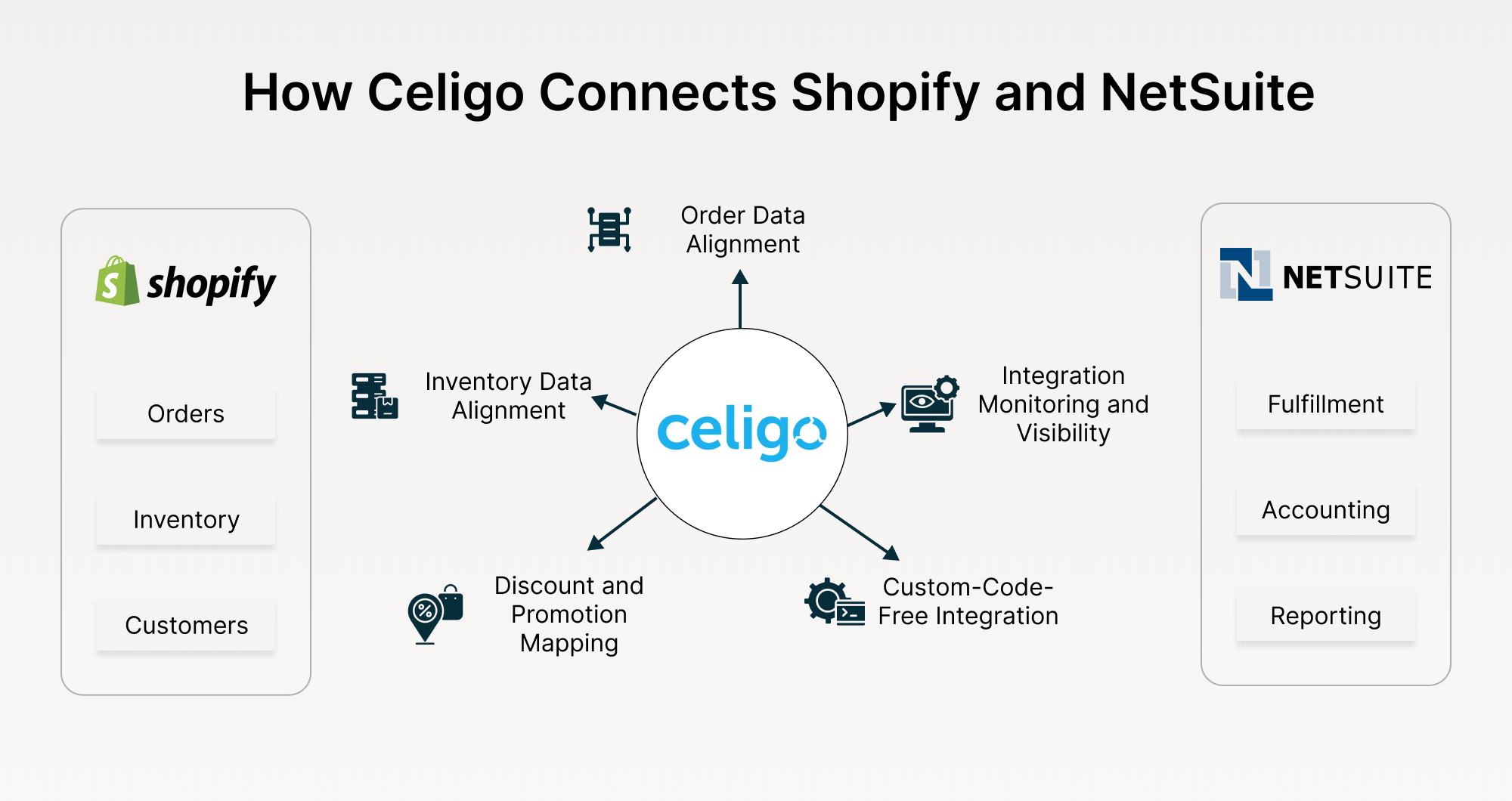
How Celigo Bridges the Shopify–NetSuite Integration Gap
When Shopify–NetSuite issues persist, the problem is that the integration isn’t designed for how your operations actually run. This is where Celigo helps.
Order Data Alignment
Shopify orders don’t stay static after checkout. Line items can be discounted, refunded, split, or adjusted. Celigo syncs these order changes into NetSuite in a structured way, reducing cases where Shopify orders not syncing to NetSuite creates fulfillment delays or requires manual correction by operations teams.
Inventory Data Alignment
Inventory is often where integration issues surface first. Celigo keeps inventory updates flowing between systems so stock levels remain consistent. This helps avoid an inventory mismatch between Shopify and NetSuite, reducing overselling risk and last-minute fulfillment checks.
Discount and Promotion Mapping
Discounts are a common failure point in any Shopify NetSuite integration solution. Celigo maps Shopify discount codes to NetSuite coupon codes, including individual line-item discounts. This eliminates manual reconciliation when promotions or gift cards are involved.
Custom-Code-Free Integration
Custom scripts often break as workflows change. Celigo enables it in Shopify NetSuite integration without custom code, allowing teams to adjust mappings and rules without rebuilding integrations or relying on constant developer support.
Integration Monitoring and Visibility
Celigo shows what synced successfully, what failed, and why. This reduces manual reconciliation between Shopify and NetSuite and allows teams to fix issues before they impact fulfillment, reporting, or finance.
What Makes Celigo Effective for Shopify–NetSuite Integration
The improvements above don’t come from surface-level automation or one-off sync fixes. They come from how the Shopify–NetSuite integration is designed to operate under real ecommerce conditions, high order volume, inventory dependencies, and system-specific rules.
Celigo supports this approach through a purpose-built Shopify–NetSuite integration app that manages workflows between Shopify and NetSuite, rather than relying on custom code or brittle point-to-point connections. This is what allows teams to maintain consistency as operations scale.
Core Shopify–NetSuite Integration Capabilities with Celigo
- Multi-Channel Order Synchronization
Sync orders from all Shopify sales channels into NetSuite to prevent missed or delayed orders during high-volume periods. - Inventory Updates Across Warehouses
Keep inventory levels aligned between Shopify and NetSuite across single or multiple warehouses to avoid overselling and stock discrepancies. - Cancellations and Refund Handling
Ensure cancellations and refunds sync across systems so operations, finance, and fulfillment teams work from the same order data. - Discount, Promotion, and Gift Card Data Mapping
Map Shopify discounts and gift cards to NetSuite line items to maintain accurate financial records without manual reconciliation. - Payout Reconciliation (Add-On)
Automatically reconcile Shopify payouts in NetSuite to surface payment gaps and maintain accurate cash flow tracking. - Retail and POS Order Support
Import Shopify POS and omnichannel orders into NetSuite so online and in-store transactions follow consistent workflows. - Store-to-Store Configuration Cloning
Replicate integration settings across Shopify stores to scale faster without rebuilding mappings from scratch.
Use Case: Resolving Order Sync Failures During Peak Sales
As a growing ecommerce brand, the company began facing challenges common during scale. Order volume increased, but Shopify and NetSuite data did not match, inventory became unreliable, and finance approvals slowed.
The challenge was clear: processes that worked at a lower scale were now slowing growth.
- Shopify orders were not syncing to NetSuite, causing fulfillment delays
- Inventory mismatch between Shopify and NetSuite created overselling risk
- Manual reconciliation between Shopify and NetSuite became routine for finance
- Customer support lacked complete order visibility, leading to slower resolutions
How Celigo Solved the Ecommerce Team’s Challenges?
By implementing a Celigo Shopify NetSuite integration, the company centralized order, inventory, and financial workflows. Orders synced automatically, inventory updates stayed aligned across systems, and cancellations, refunds, and promotions were mapped accurately.
The result was a more stable operation: fulfillment ran on time, inventory accuracy improved, data was consistent across Shopify and NetSuite, and the business scaled confidently without adding operational overhead.
Conclusion
In summary, A Celigo Shopify–NetSuite integration brings structure to your ecommerce operations by keeping orders, inventory, and financial data aligned as you grow. By replacing manual workarounds with workflow-driven automation, you gain consistency across systems and confidence in the data your teams rely on.
As a Shopify development company in St.Louis and a trusted Celigo partner, we help you design and implement Shopify–NetSuite integrations that hold up under real operating conditions, not just at launch, but as your requirements increase, making your store stable for long-term growth without adding operational overhead.
FAQ
Can Celigo support omnichannel ecommerce operations?
Yes. Celigo syncs Shopify POS and online orders into NetSuite, including scenarios like buy online, pick up in-store, so ecommerce and retail transactions follow consistent workflows.
Is Celigo suitable for businesses at different growth stages?
Yes. Celigo offers multiple editions of its integration apps, allowing businesses to start simple and expand capabilities as order volume and operational complexity grow.
How difficult is it to configure and start using Celigo?
Celigo is designed for non-technical users with guided setup and prebuilt workflows, while still supporting advanced configuration when needed.
Does Celigo automate Shopify payouts and reconciliation?
Yes. Celigo can automatically pull Shopify payout data into NetSuite, helping finance teams reconcile payments and identify discrepancies more efficiently.
Do teams need additional IT resources to manage Celigo?
Typically no. Celigo can be managed by operations or finance teams, with limited technical support only needed for highly customized requirements.
Need technical assistance?
Schedule a 30-minute discovery session with our Magento architects.
FREE CONSULTATION