AI agents have started shopping on behalf of consumers. Instead of typing a query into a search bar and clicking through to a product page, people increasingly ask an assistant to find, compare, and sometimes buy a product for them.
The agent does the legwork.
This shifts product discovery away from search engines and onto AI surfaces like ChatGPT, Gemini, Google AI Mode, and Microsoft Copilot. For Shopify merchants, that raises a practical question: when an AI agent evaluates your products against a competitor’s, what decides which one it recommends?
In this guide, we’ve explained what agentic commerce is, how it works on Shopify, how agents choose products, and what you can do to make your store agent-ready.
What Is Agentic Commerce In Simple Terms?
Agentic commerce refers to shopping powered by autonomous AI agents that can anticipate, plan, and execute purchases on behalf of consumers. Unlike traditional chatbots that simply respond to prompts, these agents reason through complex decisions, remember preferences, and take independent action to complete transactions.
The difference between a chatbot and an agentic shopping assistant is significant.
- When you ask ChatGPT for product recommendations, it provides information. When you ask an agentic agent to purchase sportswear under $100 that matches your gait type and preferred brands, they search multiple retailers, compare options, check your loyalty rewards, apply the best available discount, and complete checkout.
- That entire journey happens autonomously, which makes agentic commerce a commercial channel rather than a support feature.
The shift toward agentic commerce isn’t speculative. According to Morgan Stanley Research, agentic shoppers could account for $190 billion to $385 billion in US ecommerce spending by 2030, capturing 10% to 20% of online retail.
The more telling signal is consumer behaviour, which is already moving. Roughly 23% of Americans made a purchase using AI in the past month. The protocols are being standardised and the buying patterns are forming now – which is why product-data readiness is a near-term priority, not a future one.
The takeaway for merchants: the agent, not the shopper, now reads your product data first. If that data is incomplete or ambiguous, you may never reach the buyer at all.
How Does Agentic Commerce Work on Shopify?
The flow breaks into four stages.
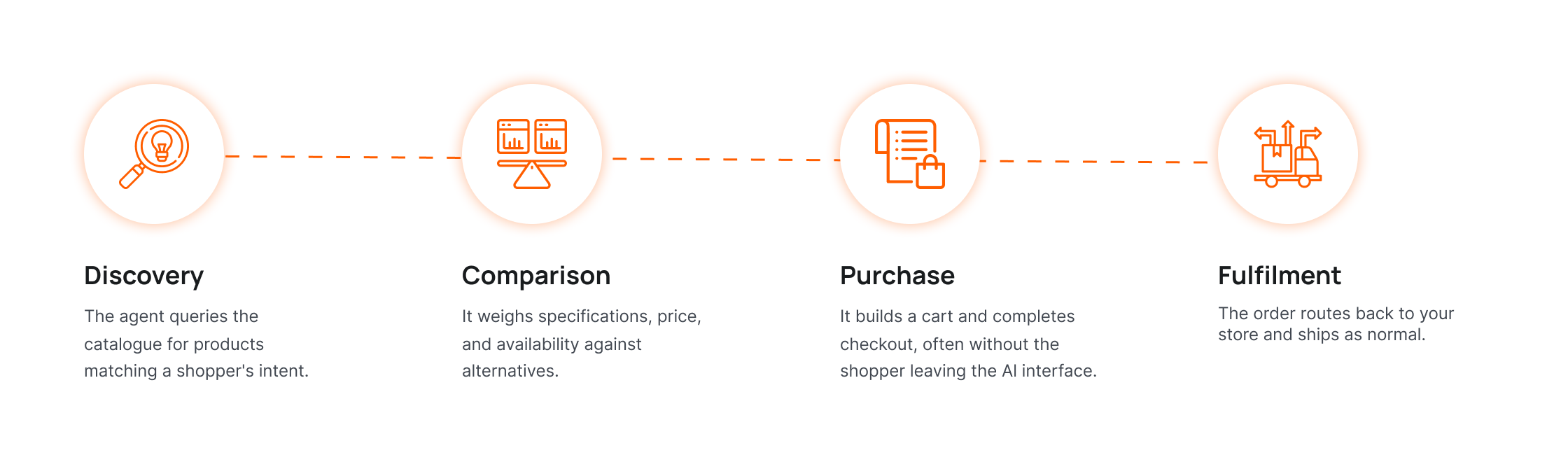
The shift becomes clearer when you put the two models side by side. In traditional ecommerce, every part of the journey is built for a human: a storefront to browse, copy to persuade, a checkout to click through.
In agentic commerce, an AI agent does that work, and it reads structured data rather than design.
The table below maps how each stage changes.
| Traditional ecommerce | Agentic commerce on Shopify |
|---|---|
| Shopper browses your storefront | Agent queries the Shopify Catalogue |
| Marketing copy persuades the buyer | Structured product data informs the agent |
| Discovery via search and ads | Discovery via AI surfaces (ChatGPT, Gemini, Copilot) |
| Buyer completes checkout on-site | Agent completes checkout via Agentic Storefronts |
| You manage one storefront | Shopify syndicates you across AI channels |
| You optimise for clicks | You optimise for extraction |
Is Your Shopify Store Ready for AI Shoppers?
Prepare for a future where your next customer might not be human.
How Do AI Agents Decide Which Products to Recommend?
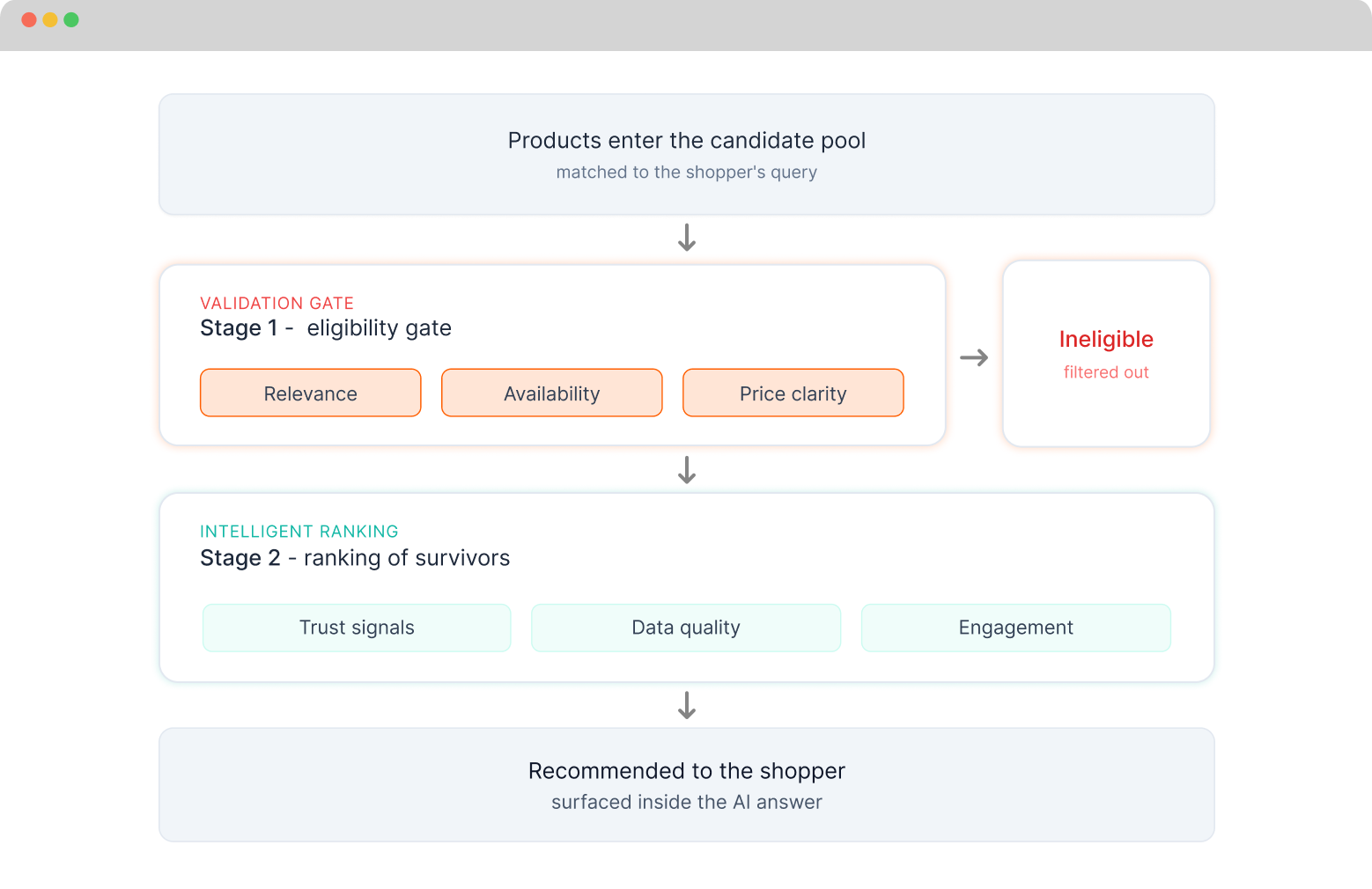
AI agents do not browse your storefront like a human shopper. Instead, they query the Shopify Catalog-the structured data layer that feeds your products into AI conversations. Because agents rely on verifiable factual data rather than persuasive marketing prose, they evaluate your inventory using a two-stage filter.
Stage 1: The Eligibility Filter
Before an agent considers your product, it must pass these “hurdles." If your product data is missing or ambiguous, the agent deems it ineligible, and your product is effectively invisible to the shopper.
- Relevance: Does the product attribute match the specific intent and criteria of the user’s query?
- Availability: Is the product confirmed in stock and purchasable in real time?
- Pricing Clarity: Is the pricing structured clearly enough for the agent to compare your product against competitors?
Stage 2: The Ranking Phase
Once a product is confirmed as a “candidate" (i.e., eligible for consideration), the agent applies the remaining signals to determine its position relative to other candidates:
- Trust Signals: Verifiable details such as return policies and accurate inventory levels that build confidence in your store’s reliability.
- Data Quality: The foundational, machine-readable attributes (such as GTINs, standardized categories, and metafields) that allow AI agents to parse, identify, and understand your product.
- Engagement Signals: Performance metrics like click-through and conversion rates that serve as evidence of a product’s appeal and real-world relevance.
The "Readability" Gap
A product might be perfect, but if its attributes are not mapped to a standard taxonomy, it can quietly cost you a match. For example, if a product color is listed as “Midnight Sky" but isn’t mapped to the standard “navy" family, the agent may not connect it to a shopper’s search for “navy items."
The agent cannot “see" your brand identity-it can only “read" your structured data. Getting these fields right is not about designing for human browsers; it is about structuring your data so that AI systems can reliably identify, parse, and rank your products.
How To Structure Product Data So AI Agents Pick You
To ensure AI agents consistently prioritize your products, you need to transition your data strategy from “persuasive marketing" to “factual precision." AI agents do not browse your site; they ingest your data.
If they cannot parse your attributes, they cannot recommend your product.
1. The Foundation: Standardized Taxonomy
- Before you do anything else, map your products to Shopify’s Standard Product Taxonomy. This is the single most effective action you can take.
- If your product is a “navy leather bag," do not rely on your internal description to tell the agent it’s navy.
- Use the specific Category field to map it to “Apparel & Accessories > Handbags." Without this, the agent is guessing, and it will skip over you to find a product it is “sure" about.
2. The Structure: Explicit Attributes
Stop relying on paragraph-style descriptions to hold your specifications. AI agents struggle to extract data from dense marketing prose. Instead, populate the dedicated fields:
- Product Titles: Lead with the defining attributes (e.g., “100% Organic Cotton Crew Neck Tee – Navy”), not brand taglines.
- Variant Clarity: Ensure every size, color, and material variant is distinct. If an agent confuses a “Medium" with a “Midnight" color, the purchase will fail.
- Attributes as Metadata: Use Metafields to store specific values-like “battery life," “material composition," or “dimensions"-rather than burying these facts in the long description.
3. The Validation: Trust & Exposure
Agents minimize risk. They prefer products that are easy to verify.
- GTINs (Global Trade Item Numbers): Always provide a valid GTIN (UPC/EAN/ISBN). This gives the agent a universal identifier to cross-reference your product across the entire web.
- Google Merchant Center: Keep this feed clean, updated, and error-free. It is the primary signal for availability and pricing accuracy.
- Structured Schema: While Shopify adds basic schema, ensure your store is surfacing the correct Product, Offer, and AggregateRating data. This confirms your pricing and stock status instantly.
The Result: You do not need to remove your creative marketing copy. Keep the storytelling for the humans. Just ensure that, alongside it, there is a clean, factual layer that an AI agent can read without guessing.
UCP vs ACP: Which Protocol Should You Start With?
With your product data now optimized for machine readability, it helps to understand the underlying infrastructure that facilitates these agent-led purchases. You will likely encounter two industry protocols that define how agents interact with your store: UCP and ACP.
Universal Commerce Protocol (UCP)- backed by Google and Shopify, acts as a full-funnel framework. It is designed to manage the entire lifecycle of a purchase-from initial discovery and product comparison through to final order fulfillment.
Agentic Commerce Protocol (ACP)- driven by OpenAI and Stripe, operates with a narrower, high-intent focus. It is designed specifically to optimize the transactional layer, streamlining how checkout and payments happen seamlessly within an AI interface like ChatGPT.
Which protocol should you start with?
- The short answer is: you don’t need to choose. Both UCP and ACP are managed automatically behind Shopify’s Agentic Storefronts.
- While they differ in scope-UCP covers the full journey while ACP focuses on the transaction-the setup is identical.
- Simply enable your desired AI channels in the Shopify admin and keep your product data and Merchant Center feed clean.
How to Get Your Store Agent-Ready: A 5-Step Checklist
With the technical landscape understood, it is time to turn these insights into execution. Use this roadmap to systematically prepare your store for AI agents:
- Audit your product data: Check every product for complete titles, attributes, and descriptions. Fix gaps and ambiguities before agents read them.
- Add GTINs: Assign valid global identifiers (UPC/EAN/ISBN) to every product and variant so agents can cross-reference your catalogue.
- Implement schema markup: Ensure your store surfaces Product, Offer, and AggregateRating schema so AI systems parse your data in a format they already understand.
- Maintain your Merchant Center feed: Keep it free of disapproved products and policy issues, ensuring prices and availability are updated daily.
- Prioritize AI measurement: Set up tagging and webhooks to begin tracking sessions from AI channels. While attribution is still evolving, baseline monitoring will help you see early performance shifts.
None of this requires re-platforming. It is data hygiene, done deliberately.
Conclusion - Preparing For The Future
Agentic commerce represents a fundamental shift in retail discovery, moving the first point of contact from human shoppers to AI agents. The brands that invest in data hygiene and structured schema now will ensure their products are not just visible, but selected when agents perform their search.
The transition won’t happen overnight, and human-centric design remains vital. But the trajectory is set; as AI becomes a dominant interface, your catalog’s machine-readability will dictate your success.
At Digital Radium, we’ve been tracking these protocols since they emerged, helping brands ensure their products are ready for this new, machine-led landscape. If you’re ready to future-proof your Shopify implementation services and ensure you’re surfaced wherever AI shoppers are browsing, we’d welcome the conversation.
FAQ
Do I need Shopify Plus for agentic commerce?
No. Most agentic commerce requirements, including structured product data, schema markup, GTINs, and Google Merchant Center optimisation, can be implemented on standard Shopify plans. Shopify Plus may be useful for advanced integrations and custom checkout workflows, but it is not required to become agent-ready.
Is agentic commerce worth preparing for today?
Yes. Preparing for agentic commerce improves product discoverability across AI assistants, search engines, and shopping feeds. Many of the same improvements, such as better product data, taxonomy mapping, and structured attributes- can benefit both your traditional ecommerce and AI-driven shopping experiences.
Do AI agents favour large brands?
Not necessarily. AI agents primarily evaluate relevance, product data quality, availability, pricing, and trust signals. Smaller merchants with accurate, well-structured product information can compete effectively alongside larger brands.
Is agentic commerce only for enterprise retailers?
No. Agentic commerce is relevant for businesses of all sizes. Foundational requirements such as product data optimisation, schema markup, feed management, and structured attributes are accessible to both small and enterprise merchants.
Will agentic commerce replace traditional online shopping?
No. Agentic commerce is expected to complement rather than replace traditional ecommerce. While AI agents may handle routine and research-heavy purchases, many shoppers will continue to browse products directly, especially for high-consideration purchases.
How do AI agents make payments securely?
AI agents do not process payments independently. Secure transactions are completed through authorised payment systems and commerce protocols that verify user intent, cart details, and payment information before checkout. These systems are supported by established payment providers and existing ecommerce security standards.
Need technical assistance?
Schedule a 30-minute discovery session with our Magento architects.
FREE CONSULTATION